When a work of art originating in a country outside the European Union arrives in Luxembourg, one question must be asked even before determining its VAT treatment:
Who owns the work of art at the time of its arrival?
This question is essential.
A Luxembourg gallery may have purchased a work from a foreign artist and import it on its own behalf.
However, very often, the arrangement is different: the artist remains the owner of the work and sends it to the gallery so that it can be exhibited and offered for sale. The gallery will only purchase it once a buyer has been found.
These two situations must not be treated in the same way.
In the first case, we are dealing with a classic import VAT issue.
In the second, temporary admission and the VAT suspension regime provided for under Article 60bis of Luxembourg VAT law may play a decisive role.
First case: the gallery already owns the work
Let us start with the simplest situation.
A Luxembourg gallery purchases a work from an artist or seller established outside the European Union.
The work is then transported to Luxembourg, and the gallery already owns it at the time of importation.
We are therefore dealing with a classic importation issue.
If the work is released for free circulation in Luxembourg, an importation takes place, and its treatment must be determined on the basis of the customs declaration, rather than solely on the seller's invoice.
This distinction is important.
The invoice documents the purchase of the work. The customs declaration documents its importation.
The latter is, in particular, what makes it possible to identify:
- the date of importation;
- the person designated as the importer;
- the taxable amount for import VAT purposes;
- and the corresponding amount of VAT.
Customs documentation also plays an essential role in securing the right to deduct import VAT: Luxembourg VAT law notably requires the taxable person to hold a document evidencing the importation and identifying that taxable person as the consignee or importer.
When the Luxembourg gallery owns the work and wishes to bring it permanently into its stock in Luxembourg, a standard importation is therefore entirely consistent with the economic flow of the transaction.
We discuss these rules in detail in our article “Import VAT in Luxembourg: 5 Common Mistakes in VAT Returns”.
Second case: the artist remains the owner of the work
The situation is very different when an artist established outside the EU sends their work to Luxembourg without selling it to the gallery.
This is a common arrangement in the art sector.
The artist wants the work to be:
- exhibited in a gallery;
- presented to potential buyers;
- potentially sold if a buyer is found;
- or returned to the artist if no buyer is found.
Upon its arrival in Luxembourg, the artist still owns the work.
The transport may be accompanied by a pro forma invoice or a document indicating a value for customs purposes. However, this document does not necessarily mean that a sale has taken place between the artist and the gallery.
This distinction is fundamental.
Why immediately importing a work that still belongs to the artist can create problems
It might seem natural to release the work for free circulation as soon as it arrives in Luxembourg.
However, if the artist remains its owner, this decision may create a subsequent VAT issue.
Suppose the work is definitively imported as soon as it arrives.
A few months later, the gallery finds a buyer and then decides to purchase the work from the artist before reselling it.
At that point, the work has already been released for free circulation and is located in Luxembourg.
The foreign artist may therefore be making a supply of goods located in Luxembourg.
This arrangement may then give rise to Luxembourg VAT obligations for the artist and, depending on the circumstances, in particular, an obligation to register for VAT in Luxembourg.
The immediate release of the work for free circulation may therefore have created a VAT issue that did not necessarily exist at the time of its arrival.
When the artist remains the owner of the work pending its sale, it is therefore important to consider the most appropriate customs procedure before the work arrives.
Temporary admission: a solution worth considering
Where the relevant conditions are met, the customs procedure for temporary admission allows non-Union goods to be used temporarily within the customs territory of the Union without being immediately released for free circulation.
Under temporary admission with total relief, customs duties and import VAT are suspended. The goods must comply with the specific conditions of this procedure and are, in principle, intended to be re-exported.
This procedure may be particularly relevant for a work that remains the property of a foreign artist and is sent to Luxembourg to be exhibited and offered for sale.
The arrangement is then as follows:
Non-EU artist
→ Physical transfer of the work to Luxembourg, without a sale
→ Placement under temporary admission
→ Exhibition of the work by the gallery.
At this stage, no sale has taken place between the artist and the gallery, and the work has not been released for free circulation.
What happens next?
If no buyer is found: the work can be sent back
First scenario: the gallery does not find a buyer.
The artist still owns the work.
Subject to compliance with the conditions of temporary admission, the work can be re-exported outside the European Union without having been released for free circulation.
The customs procedure then perfectly reflects the economic reality of the transaction:
The work temporarily entered Luxembourg to be exhibited and was then sent back without having been sold.
If a buyer is found: three stages must be distinguished
The situation becomes particularly interesting when a customer wishes to purchase the work.
Suppose the gallery then purchases the work from the artist in order to resell it to its customer.
This transaction must not be treated as a single event.
Three successive transactions must be distinguished:
- The sale of the work by the artist to the gallery while the work is still under temporary admission;
- The removal of the work from the suspension regime and its release for free circulation by the gallery;
- The sale of the work by the gallery to its customer.
Each of these transactions is subject to different VAT rules.
Step 1 – The artist sells the work to the gallery while it is under temporary admission
At the time of this first sale, the work is physically located in Luxembourg but remains under temporary admission.
Article 60bis of Luxembourg VAT law specifically provides for a particular VAT regime for this situation.
Where the relevant conditions are met, supplies of goods made under temporary admission with total relief from import duties may benefit from a provisional VAT exemption, provided that the goods remain under the same procedure.
The sale can therefore take place before the work is released for free circulation.
The arrangement is then as follows:
Non-EU artist
→ Sale of the work to the gallery
→ Work remains under temporary admission
→ Provisional VAT exemption – Article 60bis.
This mechanism is also of significant interest to the foreign artist: the law provides for an exemption from registration and the corresponding reporting obligations for taxable persons carrying out only certain supplies under these suspension regimes.
Step 2 – The gallery removes the work from the suspension regime
Once it has become the owner of the work, the gallery may decide to remove it from temporary admission and proceed with its release for free circulation.
This is where an important nuance of the Article 60bis regime comes into play.
The VAT payable at this stage must not be analysed as import VAT that is first due and then deducted.
Article 60bis provides that the exemptions granted during the suspension regime are provisional.
When the work leaves the regime, these exemptions must be regularised.
In our example, the gallery removes the work from the regime. It therefore becomes liable for the VAT due as a result of the regularisation of the suspension regime. The law provides that the amount corresponds, subject to another applicable exemption, to the VAT that would have been due on the transactions provisionally exempted, increased, where applicable, by the VAT relating to import duties and excise duties payable when the goods leave the regime.
The release for free circulation is therefore accompanied here by a specific mechanism:
Importation exempted under the scheme + removal from the suspension regime + regularisation of the VAT previously suspended.
The law also specifies that, where the goods are used for the purposes of their business and subject to the general conditions governing the right to deduct, the taxable person removing the goods from the regime may deduct the VAT paid or declared in their capacity as the person liable for this regularisation. The right to deduct arises when the regularisation is triggered.
It is therefore important not to confuse this regularisation VAT with standard import VAT: the way it is reported in the VAT return is not the same.
Step 3 – The gallery resells the work to its customer
After the work has left the suspension regime and has been released for free circulation, the gallery can sell it to its customer.
This sale constitutes a new transaction.
It must be treated in accordance with the ordinary VAT rules applicable to the sale in question, taking into account, in particular, the customer's status and the destination of the work.
We therefore obtain the complete sequence:
Non-EU artist
→ Physical transfer without a sale
→ Temporary admission in Luxembourg
→ Exhibition by the gallery
→ Buyer found
→ Sale from artist to gallery under the provisional exemption provided for by Article 60bis
→ Removal from the regime by the gallery: release for free circulation and regularisation of the suspended VAT
→ Sale from gallery to buyer: VAT treatment under the ordinary rules.
It is the chronology of the transactions that makes it possible to secure the VAT treatment.
Two works in the same gallery may therefore be subject to completely different treatment
Let us consider two paintings by the same American artist, exhibited side by side in a Luxembourg gallery.
Painting A: already purchased by the gallery
The gallery purchased the painting before it was shipped.
It owns the painting when it arrives in Luxembourg and wishes to incorporate it permanently into its stock.
We are dealing with a classic importation issue.
The customs declaration documents the importation, and the gallery must ensure that its VAT treatment is consistent with the customs information.
Painting B: still owned by the artist
The second painting has simply been entrusted to the gallery to be exhibited and offered for sale.
The artist remains its owner.
In this case, subject to the applicable conditions, temporary admission may be a much more suitable solution than immediate release for free circulation.
If no buyer is found, the painting can be re-exported.
If a buyer is found, the sequence involving Article 60bis → removal from the regime → regularisation → sale by the gallery can be considered.
Same origin, same artist, same gallery, same exhibition – but potentially very different VAT and customs treatment depending on ownership of the work and the customs procedure chosen.
And what about works sold at a fair outside the European Union?
Another common situation concerns works sold at a fair or exhibition organised outside the EU.
When the work is located outside the European Union at the time of sale and the place-of-supply rules result in the supply being located outside the EU, the sale falls outside the territorial scope of EU VAT.
To facilitate the identification of these transactions, a statement such as the following may usefully be included on the invoice:
“Sale outside the territorial scope of EU VAT – Articles 31 and 32 of Directive 2006/112/EC.”
When the purchase of the work itself takes place outside the EU at the same time as its resale, and the work never enters the territory of the European Union, that purchase does not constitute an importation into Luxembourg.
A work from the gallery's stock is sent to a fair outside the EU
Finally, it is important to distinguish a sale outside the EU from the mere movement of a work that already belongs to the gallery.
If a Luxembourg gallery ships a work from its stock to a fair held in a third country before any buyer has been identified, the physical movement of the work does not, in itself, constitute a sale.
The export customs formalities must, of course, be properly completed.
If the work is subsequently sold during the fair, the VAT treatment of that sale must be determined according to the location of the work and the circumstances of the transaction.
The 4 questions to ask before a work arrives in Luxembourg
In the art sector, the VAT and customs treatment should ideally be determined before the work is shipped.
Four questions already make it possible to identify the key elements of the arrangement:
1. Who owns the work?
Has the gallery already purchased it, or does it remain the property of the artist?
2. Why is the work coming to Luxembourg?
Is it intended to be permanently incorporated into the gallery's stock, or is it simply being brought in for exhibition while awaiting a possible sale?
3. Under which customs procedure should it enter?
Immediate release for free circulation or, where the relevant conditions are met, temporary admission?
4. What will happen once a buyer is found?
Who will sell the work, who will remove it from the customs procedure, and who will make the sale to the final customer?
These questions must be asked before customs clearance, because the procedure chosen upon arrival may have consequences several months later, at the time of sale.
In the art sector, VAT and customs must be considered together
Works of art illustrate particularly well the importance of an approach that combines VAT and customs.
An analysis limited to the commercial invoice may overlook the real issue.
At VAT Solutions, we analyse the entire flow: ownership of the work, physical movement, customs procedure, sale under the suspension regime, release for free circulation, regularisation under Article 60bis and subsequent sale.
Our dual expertise enables us, in particular, to assist galleries, artists and other professionals in the sector with:
- determining the appropriate customs procedure before the work arrives;
- ensuring that temporary admission is used correctly;
- handling standard importations when the gallery already owns the work;
- analysing sales carried out under a suspension regime;
- ensuring the correct application of Article 60bis and its regularisation;
- avoiding the unnecessary creation of VAT obligations for foreign artists;
- and reconciling customs documents, invoices and VAT returns.
To explore the general rules relating to importations in greater detail, also read our article:
“Import VAT in Luxembourg: 5 Common Mistakes in VAT Returns”.
In the art sector, the correct VAT and customs treatment therefore begins with a very simple question: who owns the work when it arrives in Luxembourg?
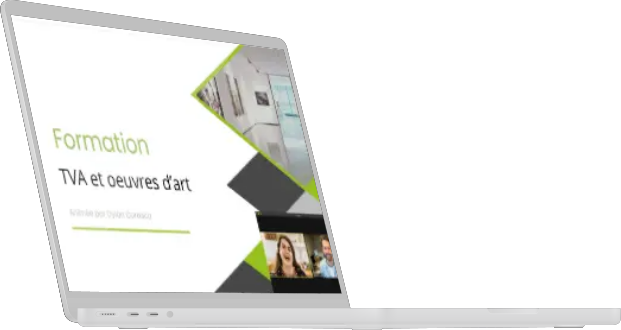
VAT training on works of art
The training is delivered by a VAT expert specialized in international transactions within the art sector.
The objective is that, by the end of the course, you will have a solid understanding of the VAT rules applicable to the purchase and sale of works of art, be able to identify the related obligations depending on the applicable regime, and secure the VAT treatment of transactions carried out by art galleries, art agents, or artists.